6.02
Part 06 · The long game · Points
Skill Points, and what earns them
Every point comes from something you did, and nothing ever takes them away.
Where this is in iWhisk
Journey
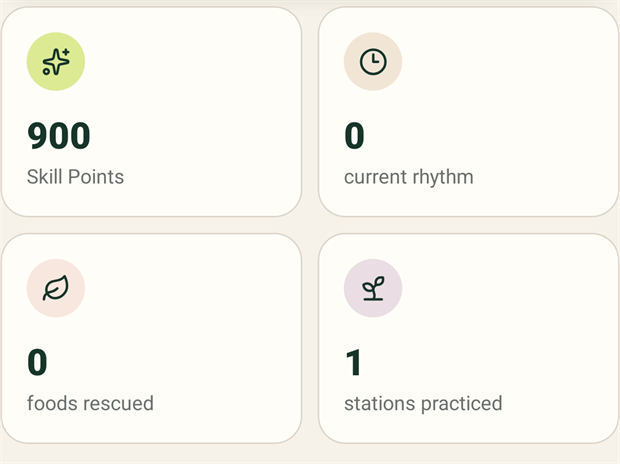
Skill Points, shortened to SP in places, are how iWhisk measures cooking you have actually done. They are progress and nothing else: they cannot be purchased, transferred to another person, or redeemed for money or for anything money buys.
6.02.1
Where points come from
- Cooking something with Guided Cooking. The largest single source. A harder recipe is worth more than an easy one. Note the wording: it is cooking it with iWhisk that earns, not telling iWhisk afterwards. See 5.06.
- Rescuing food, meaning you used something in the days before its use-by date rather than after it.
- Refreshing your kitchen picture by saving a capture.
- Rating something you made.
- Finishing a goal.
If an action earns points, it appears in the Skill Point ledger on Journey with the reason it was given. The app puts it better than we can: every point has a reason, and the ledger is the explanation for your progress rather than just a score. Anything that does not appear there earned nothing, and that is deliberate. A total you cannot account for is not worth showing you.
6.02.2
Cook lanes, and what iWhisk means by harder
A harder recipe is not a dearer one, and it is not one with a longer shopping list. It is one with more cook lanes: separate things on the go at once, each on its own clock, all of which have to arrive together as a single dish.
One lane is a tray of vegetables in the oven. Four lanes is a joint resting while a sauce reduces, a starch finishes, and something green goes in at the last minute, and all four landing hot at the same moment. What makes a recipe difficult is the activities themselves and how tightly their timings depend on one another, rather than the count. Two lanes that have to meet within a minute of each other are harder than four that do not much care. Difficulty is what decides what a cook is worth.
Which means none of the following makes a recipe harder:
- Time by itself. A braise that sits for four hours while you look in occasionally is one lane, not four.
- The length of the ingredient list. A salad with twenty things in it is still one lane.
- Cooking the same easy thing repeatedly. Ten of them is ten easy dishes, not one hard one.
- How hard it felt on the night. The rating describes the dish, not the evening you had. Everybody has fought a simple recipe at some point.
The five steps, from fewest lanes to most, are Foundation, Building Blocks, Intermediate, Advanced and Mastery.
6.02.3
Nothing is ever deducted
Letting food expire costs you nothing. Marking food tossed costs you nothing. A quiet couple of weeks costs you nothing. All three are recorded, because they make your goals sharper, but not one of them is a penalty.
This is worth saying plainly, because most things that count do subtract. Your total only ever rises or holds still.
6.02.4
Cooking the same thing twice
Cooking a recipe you have made recently pays less than the first time did. Leave it a while and it pays in full again.